Historic Resting Place for Famous and Faithful

by Christine McCullough Friend

Commodore John Barry, father of the American Navy. George Meade, grandfather of Civil War hero General George Meade. Katrina, Philadelphia servant. Katrina?

What does a servant girl have in common with these decorated war heroes and well-known patriots? They share a final resting place in Old St. Mary’s Cemetery where the famous and the ordinary lie side by side.
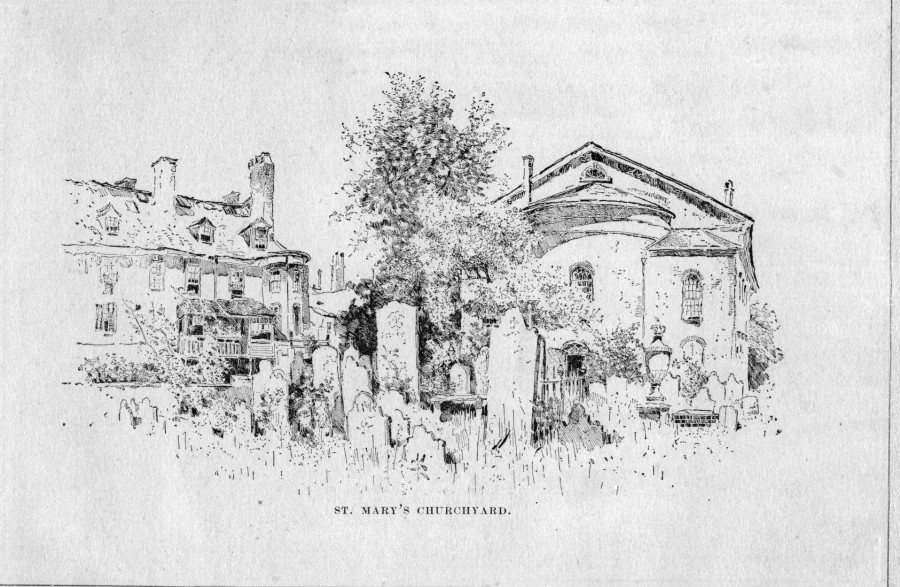
Old St. Mary's Churchyard, engraving, n.d.

The cemetery lies in the heart of Philadelphia’s historic district at 4th and Spruce Streets. The earliest tombstone inscription bears the date 1760. Before the establishment of the cemetery, Catholics were buried in a tiny plot adjoining Old St. Joseph Church (est. 1733) as well as in the Catholic section of the public burial ground at Washington  Square.   

In the latter part of the 18th century, the German congregation of Holy Trinity acquired a strip of land from St. Mary’s to be used specifically for burials of their members.  The two parishes continued to share the burial ground for the next century.

Early meetings of St. Mary’s Board of Trustees, which are documented in the parish’s Minute Books, discuss resolutions concerning the burial ground, including who had permission to be buried there and the costs required. A meeting of the Board on May 4, 1789 states, “For every Pewholder or any of their Families (except Apprentices or Servants) above the age of Fifteen-Twelve Shillings & 6d-between fifteen and five-Seven Shillings & 6d. & all under Five years Five Shillings. ‘For’ Strangers and others not being Pewholders he shall demand double the above sums according to their Ages. The Poor shall be buried Gratis-…”  

Minute Book of Old St. Mary, May 4, 1789

John Barry

 Perhaps the most famous grave in Old St. Mary’s is that of Commodore John Barry. A native of County Wexford, Ireland, Barry served with distinction during the War for Independence, and was the first Commander- in- Chief of the United States Navy. 

Bishop Egan, the first Bishop of Philadelphia, was initially interred in Old St. Mary’s. In 1869, his remains were removed to the vault beneath the Cathedral Basilica of SS. Peter and Paul.

During the American Revolution, a French general who fought at the Battle of Brandywine drowned in the Schuylkill River. General Philippe C. Ducoudray was crossing the river on the Market Street Ferry when his horse leaped over the side, with the general on its back. The general was buried at Old St. Mary’s, although the exact location of his grave is not known. One of the last acts of the Continental Congress before the British occupation of Philadelphia was to attend General Ducourday’s burial.

Hundreds of ordinary Catholics lie in unmarked graves alongside these famous burials. One that bears mention is Katrina, a poor servant whose last name was never recorded.

According to Catholic historian and journalist Martin I.J. Griffin, Katrina moved to Philadelphia from Lancaster to receive the ministry of the Jesuit Father Ferdinand Farmer. She worked as a servant of an innkeeper in Philadelphia. Katrina survived the yellow fever epidemic that ravaged the city in 1793.

Fear of the fever was so great that survivors sought protection even from the dead. For sanitary reasons, over 2,600 loads of earth were spread over the surface of Old St. Mary’s Cemetery, raising the burial ground. Katrina, in order to secure a free burial, offered to spread one hundred loads of earth by hand. She died several years later after sustaining crippling injuries in a fire. True to her wishes, Katrina was buried in Old St. Mary’s Cemetery beneath the soil she helped spread. Her unmarked resting place remains unknown.

Time and weather have taken their toll on this cemetery, rendering many tombstones unreadable. In 1891, the American Catholic Historical Society published a list of the inscriptions of those tombstones that were still legible to document the deteriorating written record.

Sketch of Old. St. Mary's burial ground at Spruce St. between 4th and 5th Streets, ca. 1891

Fitting memorials mark many of the graves in the cemetery. Other graves contain the remains of the not-so-famous faithful, who labored to build the Church in Philadelphia.


More information about Old St. Mary and its cemetery(ies) can be found in the Records and Researches of the American Catholic Historical Society. Along with other materials relating to Old St. Mary, PAHRC has the parish’s Minute Books from 1788-1899.

Jane and Marianne Campbell: Catholic Feminists

I recently completed processing and creating a finding aid-available online- for the collection, Martin-Campbell-Furlong Family Papers, 1795-1963 (MC 90)  . Before moving on to another project, I wanted to bring attention to two more family members who are documented within this collection, Sarah Jane Campbell (1844-1928) and her sister Marianne Campbell (1840-1913). Jane and Marianne were two of the few 19th- and early 20th century prominent Catholic women feminists who advocated for women’s equality, specifically a woman’s right to vote. Both were very active within the women’s suffrage movement until the passage of the nineteenth amendment.

Sarah Jane Campbell

Jane, a prolific writer and speaker, was considerably visible within the suffrage movement. In 1892, she founded the Women’s Suffrage Society of Philadelphia, and served as its president for 22 years. She was also on the executive board of the Pennsylvania Women’s Suffrage Association and represented Philadelphia in the American Women’s Suffrage Association. She served as a delegate to the national and state conventions and was often in demand as a speaker. 

Marianne Campbell

The mouthpiece for Jane and Marianne’s views came in the form of the magazine Woman’s Progress in literature, science, art, education, and politics, which Marianne founded in 1893. Jane served as the magazine’s editor. Under the pseudonyms “T.S. Arthur” and “Catherine Osborne,” Marianne contributed many articles.

The periodical, according to its editor, was to “be a high class monthly magazine devoted to the best interests of Women. It is the intention of the editor,” the first issue’s editorial announcement notes,” to keep women informed of the various opportunities that are open to them; of their political status in different parts of the world; and of their work in Literature, Art, Science and Education.” In the journal, Jane called for political equality while writing essays about Catholic women’s past achievements in education and charitable work.


Jane and Marianne were also involved in numerous Catholic, civic, Irish-American, botanical, and historical organizations and associations, such as the American Catholic Historical Society for which Jane served as recording secretary for a time, as well as the City History Society of Philadelphia, the Audubon Society, St. Vincent’s Aid Society, the Civic Club, the Mercantile Club, and the Women’s Press Club among others. Long-time residents of Germantown, they were also actively involved in the social and cultural affairs of this section of the city.

Jane also contributed to several Philadelphia newspapers, including The Philadelphia Inquirer, the Record, and the Ledger writing about a multitude of topics. She also wrote children’s folk tales for the Record and contributed to Catholic publications, including the Rosary Magazine of New York, the Catholic Messenger, and the Records of the American Catholic Historical Society.

As an art teacher who worked in Philadelphia’s public schools for fifty-five years- her last position as Head of the Art Department at the Girls’ Normal School- Marianne was deeply devoted to and active in her profession. She was pivotal in the formation of the Teachers’ Annuity and Aged Society for the care of aged teachers. Marianne herself was an artist having studied at the Academy of the Fine Arts, often entering paintings in its annual exhibitions.

Although there is only a limited amount of documentation for Marianne Campbell, including a few letters, obituary notices, and estate items, there is a decent amount of correspondence to and from Jane Campbell. The majority of these letters are from Jane to the family of William J. and Elizabeth Martin Campbell who lived with Jane and Marianne. Some document Jane’s involvement in the suffrage movement as well as her involvement in numerous associations and clubs, and reveal her political, religious, and family loyalties. For example, in the following letter written from Portsmouth, Rhode Island- which had ratified the 19th amendment several months prior- Jane writes We are staying over here to attend a Jubilee Suffrage meeting, the practical dissolution of the Newport and Bristol Ferry Suffrage Society. The women in Rhode Island have Presidential Suffrage…so that they can pass their ballots in the Presidential elections. The Rhode Island Constitution gives the Legislature the power of conferring Pres. Suf. on women and the Legislature has done so. I saw the Providence Journal of yesterday…but there was nothing from Tennessee where the battle of the 36th state is being fought, maybe it is already decided but I have no means of knowing for perhaps some days. (Five days later, Tennessee became the 36th state to ratify the amendment.)

Jane Campbell to her nephew John J. Campbell, August 13, 1920, p.1

Jane Campbell to her nephew John J. Campbell, p.2

Other materials relating to Jane include her will, and land deeds for the property she and Marianne purchased in Germantown.

PAHRC has an almost complete set of Woman’s Progress magazine (Call # PER-W).

Patrick Coad, patentee of the galvanic battery, and interesting miscellaneous items

I am almost finished processing a small collection, Patrick Coad Family Papers (MC 37). An online finding aid will soon be available.

Patrick Coad, undated

Patrick Coad (1783-1872), an Irish immigrant who settled in Philadelphia, was the first American patentee of a graduated galvanic battery with insulated poles. Coad was a noted teacher and lecturer of medicine and the natural sciences, but gained wider notoriety after he invented and patented his galvanic battery in March 1842. The patent Coad received was for the “improvement in the mode of constructing the galvanic battery so as to vary the intensity of its effect, and in the construction of insulated conductors applied to the same for adapting it to medical purposes.” The instrument, which Coad and others touted as one that helped cure various diseases, garnered a good deal of attention within the medical community, which at the time was very interested in the use of electricity and magnetism for medical treatment.

Pamphlet with information on how to use Coad's galvanic battery during surgical procedures, 1844

Broadside publicizing Coad's lectures, undated

The collection includes some of Coad’s correspondence, his lecture notes and medical remedies, testimonials noting the capabilities of his galvanic battery, as well as related ephemera. Ephemeral materials include newspaper clippings, pamphlets and broadsides publicizing his invention, lectures, as well as the school that Coad opened for boys and girls. Also included in the collection is correspondence, ephemera, some estate items, and a scrapbook relating to Patrick Coad’s family, including his son Joseph R. Coad (1829-1868), a prominent Philadelphia physician who served as president of the city’s Board of Health.

Dr. Joseph R. Coad, circa 1860

Thus far, I have found that manuscript collections, particularly collections of family papers, often have some interesting miscellaneous items that seemingly have nothing to do with the family that is being documented. This collection is no exception. The following are two items that I felt warranted some attention:

1. A document listing the number of those in the city who died during the Yellow Fever epidemic in (possibly?) August and September 1798. The deaths are broken down by religion, church, and section of the city. (These obviously are in need of conservation!)

Yellow fever deaths, September 1798

Yellow fever deaths, Summer 1798

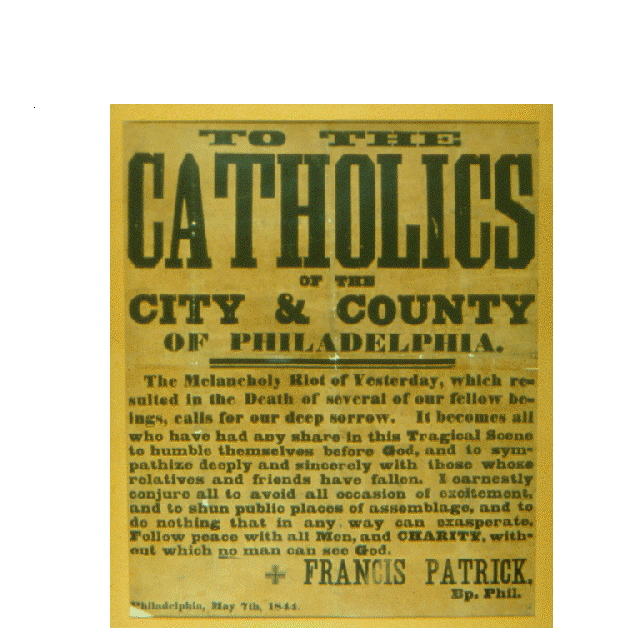
2. The other item of interest is another list, this one a list of food items requested by military personnel and civilians who were stationed at St. Paul’s Church during the first phase of the Nativist riots in May 1844. After violence had spread from Irish Kensington to the city of Philadelphia itself, authorities and citizens finally took action. On Thursday, May 9, Philadelphia County was placed under martial law. Several thousand of the city’s elite formed into divisions of “Peace Police” and assisted the militia in guarding the Catholic churches of the city for the next several days.

It appears as if these soldiers and citizens were not going to defend their city without proper nourishment, which included ham, veal, poultry, eggs, 10 pounds of sugar, and 2,000 stewed and 600 fried oysters. Oh yes, and don’t forget the segars.

Food ordered by military personnel and citizens guarding St. Paul's Catholic Church, May 1844

Philadelphia’s First Bishop

by Christine Friend

Philadelphia’s first Bishop, the Irish-born Franciscan Michael Egan, was appointed a full century after the American colonists began the practice of their Catholic Faith in the New World.

Bishop Michael Egan, n.d.

Bishop Michael Egan, n.d.

The colony of Pennsylvania, chartered in 1681 with William Penn as proprietor, offered the safety of religious tolerance, but 50 years passed before great numbers of Catholics settled in the colony.

The English-born Jesuit, Reverend Joseph Greaton, lived in Maryland as early as 1720, and traveled to Philadelphia to offer Mass and administer the sacraments.  By 1729, Father Greaton had taken up residence in Philadelphia, discreetly celebrating Mass in private homes.  In 1733 he established the first parish in Philadelphia, Saint Joseph’s Church, in a secluded alley near 4th and Walnut Streets.

By the eve of the American Revolution, Philadelphia was the largest city in North America.  While under the jurisdiction of the Bishop of London, attempts were made to create a diocese with a resident bishop, but colonial priests discouraged this effort.  Fearful of re-igniting fierce anti-Catholic sentiment, and concerned about the public duties required of a bishop, American colonial priests declined all offers to establish an episcopate, or to allow a bishop to visit the colonies.

The first American diocese was established in Baltimore in 1789, under the leadership of Bishop John Carroll.  The boundaries of this singular diocese encompassed the entire United States.

Between 1790 and 1820, one-quarter-million immigrants arrived in the United States.  By 1810, the city and county of Philadelphia had over 100,000 inhabitants.

As the number of Catholics in the United States grew, Bishop John Carroll of Baltimore suggested that his immense diocese be divided, and in 1808 the Dioceses of Philadelphia, New York, Boston and Bardstown, Kentucky were established.

The newly formed Diocese of Philadelphia encompassed all of Pennsylvania and Delaware, and the southern half of New Jersey. Just two years later, the Diocese of Philadelphia had approximately 11 priests, 16 churches and 30,000 Catholics.

Archbishop Carroll nominated Reverend Michael Egan as the first bishop of the newly formed Diocese of Philadelphia. Carroll described Egan in his letter of nomination as “truly pious, learned, religious, remarkable for his great humility, but deficient perhaps, in firmness and without great experience in the direction of affairs.”  This description would prove prophetic, as Egan’s episcopate was marred by administrative disputes with lay trustees.

Egan was born in 1761 in Limerick, Ireland.  As a young man he joined the Order of Friars Minor, and studied at Louvain and Prague, where he was probably ordained.  Several members of Bishop Egan’s family came to the United States during his tenure, and settled in Philadelphia.

Egan’s permanent residence in the United States began in 1802, although he may have been in the U.S. briefly in the summer of 1798.  He arrived in Albany, New York, but since he was not needed there, traveled to Saint Mary’s Church in Lancaster to work with Father Louis de Barth.  (Father de Barth, a life-long friend of Bishop Egan, would eventually succeed Egan as administrator of the Philadelphia Diocese until its second bishop, Henry Conwell, was appointed in 1820.)

Father Egan’s excellent reputation for preaching greatly appealed to the prestigious congregation of Saint Mary’s in Philadelphia.  The lay trustees elected him as one of the pastors in 1803, and Father Egan moved from Lancaster to Philadelphia.  After Egan’s appointment as bishop, Saint Mary’s became the diocesan procathedral (an existing parish church used as a cathedral).

Engraving of Old St. Mary, n.d.

Engraving of Old St. Mary, n.d.

Michael Egan was named the first bishop of the Diocese of Philadelphia in April 1808, although political conditions in Europe and slow communications from Rome contributed to the delay of his consecration.  The ceremony finally took place in Baltimore in St. Peter’s procathedral on October 28, 1810, more than two years after his official appointment.

The newly appointed Bishop Egan soon found himself embroiled in disputes with lay trustees, and swayed by the dominant personality of his fellow priest, Reverend William Harold.   Bishop Egan suffered ill health for many years, with symptoms suggesting tuberculosis.  His poor health was exacerbated by the almost yearly outbreaks of yellow fever in Philadelphia.  During these outbreaks, over half the city residents fled to the country, and churches and gathering places were nearly empty.  Streets were piled high with coffins awaiting burial, and cries of “bring out your dead” echoed through the city.

Bishop Egan’s weakened physical state may have contributed to some of the administrative problems he encountered during his years in Philadelphia.  The growing debt at Saint Mary’s prompted the lay trustees to suggest decreasing the number of priests serving the congregation, as well as reducing the salaries of the remaining priests.  Egan found himself embroiled in conflicts with a radical faction of forceful lay trustees, who challenged the authority and jurisdiction of priests and bishops.

Draft of Trustees' report (April 13, 1812) suggested layoffs or decrease in clergy salary to combat the church's growing debt

Draft of Trustees' report (April 13, 1812) suggesting layoffs or a decrease in clergy salary to combat the church's growing debt, page 1

Trustees' report, page 2

Trustees' report, page 2

Egan vowed to be more assertive and tried to amicably resolve disputes, but his mild nature restricted his authority.  Divisions within the Philadelphia church remained, and tensions grew among the clergy based on issues of trusteeism and the extremely public nature of the conflict.  This upheaval in the Philadelphia church persisted even after the death of Philadelphia’s first bishop on July 22, 1814, at age 53.  The See remained vacant for the next six years, until Philadelphia’s second bishop, Henry Conwell, was appointed.

Bishop Egan was buried in the cemetery adjoining Old Saint Mary’s Church.  His remains were moved in 1869, along with those of Bishop Conwell, to the specially constructed crypt for the bishops of Philadelphia beneath the Cathedral of Saints Peter and Paul.

Two collections that relate to this topic include St. Mary’s Church (MC-41) and the Bishop Michael Egan Papers (MC-70).  Information about Bishop Egan, St. Mary’s Church, and the issue of trusteeism can also be found within the Records of the American Catholic Historical Society in PAHRC’s collection.