1832 Cholera Outbreak in Philadelphia and Duffy’s Cut

Lately, there has been a fair amount of news coverage (“Fates Of Irish Workers Sealed In Mass Grave”, “Pennsylvania Ghost Story Leads to Murder Mystery”, “CNN Visits Penn Museum to Follow Story of “Duffy’s Cut” Excavations in Malvern, PA”) about the mystery surrounding “Duffy’s Cut,” a stretch of land in Chester County where, during the summer of 1832, 57 Irish laborers died. The men were hired by labor contractor Philip Duffy to construct mile 59 of the Pennsylvania and Columbia Railroad. The cholera epidemic that was ravaging parts of the U.S., including New York City, spread to Philadelphia and reached the laborers’ camp in mid-August. Within two and a half weeks, all of the men were dead.   
All of the deaths were blamed on the disease; however, historical documents and local stories suggest that some of the victims may have been murdered by locals, antagonistic to Irish Catholics, who wanted to prevent the outbreak from spreading. A few years ago, scholars and other interested parties began an archeological dig at the site of the mass grave to try and determine whether foul play had indeed occurred.       

Although downplayed in histories concerning the 1832 cholera epidemic, the toll that the disease took on Philadelphia that summer was high. Many residents fled from the city to the countryside. August proved to be the worst month with well over a hundred cases a day reported. A significant number of those cases resulted in death.  The worst days in the city were August 6, when there were 176 cases and 71 deaths, and August 7, when there were 136 cases and 73 deaths reported.      

There was a fairly organized and concerted effort on the part of the medical community in the city during the early months of the outbreak. However, by August medical personnel were overwhelmed and began to seek outside help. The Committee of the Almshouse, later known as Philadelphia General Hospital, asked Bishop Kenrick if he could request the help of the Sisters of Charity to serve as nurses. The order, founded by Elizabeth Ann Seton, already had a presence in the city. In 1814, at the request of then Bishop Egan and Fr. Michael Hurley, pastor of St. Augustine’s Church and close friend of Mother Seton, sisters began working in St. Joseph’s orphanage.       

Sister Rose White, first sister servant of St. Joseph's Home, no date

Kenrick agreed to contact the order.  In addition to the five sisters already in Philadelphia, eight others were sent from the motherhouse in Maryland. They lived and worked in the Almshouse and other hospitals, including St. Augustine Church, which Fr. Hurley had turned into a makeshift hospital under the supervision of Dr. Oliver H. Taylor.        

Father Michael Hurley, no date

Four Sisters of Charity were also called upon to minister to the dying men at Duffy’s Cut. Their presence was recorded from the accounts of an eyewitness; however, no official record of their mission exists. Relevant documents may have been destroyed in the fire at St. Augustine’s several years later. Ironically, although most of the patients cared for by the Sisters of Charity at St. Augustine were recorded as being non-Catholic, the church was not spared by Protestant nativists when it was burned to the ground during the riots of 1844.       

Lithograph of St. Augustine in ruins, 1844

Cholera had run its course in Philadelphia by early September. None of the sisters who ministered in the city and at Duffy’s cut during the outbreak perished from the disease. Their assistance, as well as that of Bishop Kenrick and Father Hurley, was publicly recognized by the city. The Board of Health and the Almshouse Committee recognized their efforts, and the city awarded silver plates to the sisters and thirteen physicians who had played a prominent role during the outbreak. The sisters declined the offer, instead asking that the money used to make the plates be used as funds for the orphanages and schools that the order administered.          

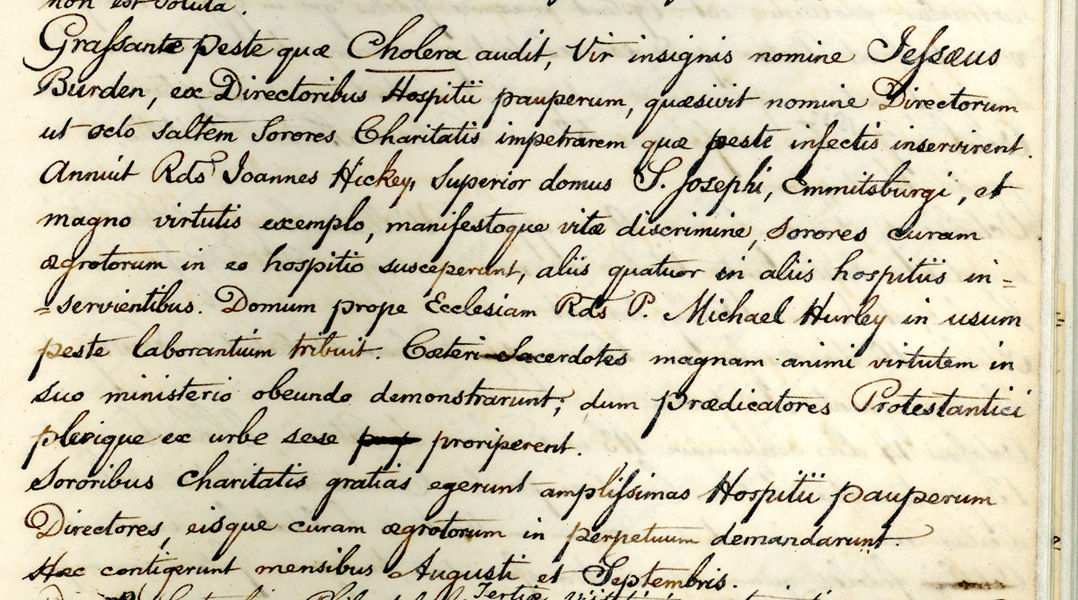
 In his diary, Bishop Kenrick commented on the noteworthy efforts of the sisters and priests during the outbreak: “…displaying an example of heroic fortitude, with certain peril to their lives, the Sisters took charge of the pest-stricken patients in that Hospital. Four others of the Sisters gave their services in other hospitals…priests proved their character and their strong virtues, caring for the sick in the exercise of the sacred ministry; while non-Catholic ministers generally fled from the city.”       

Excerpt from Kenrick's diary, September 22, 1832

Kenrick was one among many prominent religious figures of all Christian denominations in the United States and Britain who viewed the outbreak as punishment for people’s sins, specifically those dealing with the overindulgence of food and drink. And although Kenrick greatly assisted those affected by the disease, in a letter to Bishop Rese of Detroit, Kenrick shares his view of the outbreak as sort of a blessing in disguise in that it allowed many to reflect on their lives and come to terms with death. He writes, “The cholera has done great good in Philadelphia. Many are prepared for death, frightened from daily examples of unexpected deaths.”   


Excerpt from Kenrick letter to Bishop Rese, August 16, 1832

References:  McGowan, Francis X., ed. Historical Sketch of St. Augustine’s Church, Phila., Pa. Philadelphia: The Augustinian Fathers, 1896.    

Prendergast, Edmond, ed. Diary and Visitation Record of the Rt. Rev. Francis Patrick Kenrick, 1830-1851. Lancaster, Pa: Wickersham Printing Co., 1916.    

Watson, William. “The Sisters of Charity, the 1832 Cholera Epidemic in Philadelphia and Duffy’s Cut.” U.S. Catholic Historian 27no. 4 (Fall 2009): 1-16.    

For more information on Duffy’s Cut see:    

Watson, William E. et al. The Ghosts of Duffy’s Cut: The Irish Who Died Building America’s Most Dangerous Stretch of Railroad. Westport: Praeger Publishers, 2006.    


A Philadelphia Artist

I’m currently processing the Campbell- Martin- Furlong Papers, a collection of papers that documents these three interrelated Catholic families as well as other related families such as the Kennedys and Jenkins.  Most of items are family correspondence, though some business and estate materials are also included. One member of the Martin family who is fairly well-represented in the collection and who caught my attention is William A. K. Martin (1816-1867). Other than family correspondence, a decent amount of letters and other items deal with Martin’s career as an artist. 

Martin’s works primarily included landscape, portrait, and maritime paintings, specifically paintings of U.S. Naval ships. He also painted works with religious themes. A parishioner and friend of St. Philip Neri’s first pastor, John Patrick Dunn, Martin donated one of his first paintings, depicting the Scourging of Christ at the Pillar, to the church. The painting, which hung above the altar of the church, was described in detail in the April 21, 1842 issue of the Catholic Herald in an article entitled, “Beautiful Painting.”  

The Catholic Herald April 21, 1842

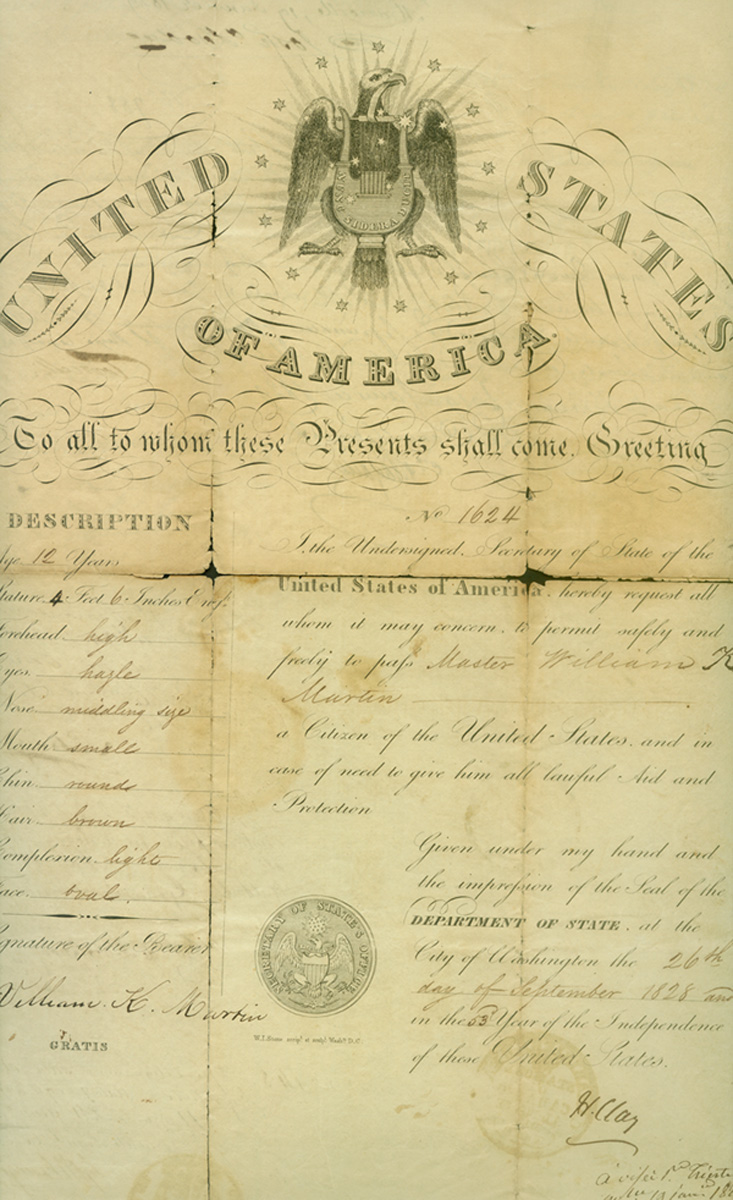
Martin’s preoccupation with maritime subjects resulted from the fact that several members of the Martin and related families were merchant captains. William’s father, Captain John Martin, mainly conducted business with New Orleans and the Caribbean as well as Western Europe and China. William spent much of his young life at sea. One item in the collection includes his passport from age 12-signed by Secretary of State Henry Clay- when he travelled through Europe. 

William A. K. Martin's passport, 1829

From the turn of the century up until the mid 1800s, Philadelphia served as the preeminent city for artists in the country, particularly portrait artists and lithographers. Thus, Martin was privy to a vibrant artistic scene. He was able to receive tutoring in portrait painting from notable artist John Neagle. Martin was also a member of the Artists Fund Society and Pennsylvania Academy of the Fine Arts which held annual exhibitions to sustain art activity in the city. 

Receipt of payment for lessons in portrait painting with John Neagle, January 9, 1841

Letter from noted lithographer John Sartain with information regarding a meeting of artists associated with the Academy of Fine Arts, January 15, 1856, p.1

Sartain letter, p.2

Martin’s correspondence and business-related materials appear to demonstrate that Martin had a fairly steady amount of business in his home town. His work garnered some interest outside Philadelphia as well. He was asked to exhibit paintings at the Metropolitan Mechanical Institution in Washington D.C.  Moreover, Librarian of Congress, John Silva Meehan took an interest in his paintings. Meehan worked on Martin’s behalf to have him hired to paint a marine subject for one of the panels in the new extensions of the U.S. Capitol building. 

Letter from John S. Meehan to W.A.K. Martin, February 2, 1857

Although Meehan urged Martin to begin work on the project in order to provide members of Congress with a taste of what they could expect, Martin did not want to begin such a large endeavor without certainty that he would be hired for the job. With the recent birth of his fourth child, Martin writes: My pecuniary situation with an increasing family is such as to place it out of my power to incur the expense and loss of time such as I did on the prior occasions, unless with a certainty of success and as ‘hope deferred maketh the heart sick’ and doubting I fear that this twin hope is doomed to meet the fate of its brother killed by an omnibus. Hope however lingers to the last. Thus, the opportunity to have his work displayed in the Capitol building did not come to fruition. 

W.A.K. Martin to John S. Meehan, February 12, 1857, p.1

Letter to Meehan, p.2

Anti-Catholicism in Jacksonian Philadelphia

Anti-Catholicism was present in America since its founding though, by the early 19th century it had become “largely rhetorical.” The influx of Catholic immigrants, however, as well as the increasingly aggressive and authoritarian stance of the papacy, which became more outspoken in its denunciations of modernism and liberalism, established a fear that Catholics posed a genuine threat. Conspiracy theories of a papal takeover of the United States abounded.  

 A large dimension of the Protestant revival that began in the late 1820s included militant attacks against the Catholic Church which claimed that the Catholic religion was threatening to America’s Protestant culture. Nativists and evangelicals characterized Catholicism as an authoritative religion incompatible with republicanism. Viewed as submissive and unquestioning followers, those of Catholic faith were seen as lacking the individuality and free thinking required of democratic citizens. Moreover, the Catholic immigrant, whose allegiance was to a foreign ruler, was seen as disloyal to America.               

 Anti-Catholic sentiments led to violence in the summer of 1834. Sparked by rumors that nuns were being kept against their will, a mob attacked and burnt to the ground an Ursuline convent and school (attended mostly by the daughters of wealthy Protestants) in Charlestown, Massachusetts. Fortunately, no one was killed.        

Philadelphia became one of the centers of anti-Catholic protest, second only to Hartford Connecticut in the amount of anti-Catholic materials published. The trustee problems that plagued Philadelphia beginning in the 1820s played a significant role, badly damaging the reputation of Catholics and left Philadelphians suspicious of the motives of the Catholic hierarchy.    

In this pamphlet published in Philadelphia in 1833, Samuel Smith, a former priest, discusses what he sees as significant problems with the Catholic Church


Trusteeism involved the practice of Catholic laity assuming control of the administration of churches, even to the point of hiring and firing pastors. This practice began in colonial times when laymen raised money, purchased land, and built churches themselves due to the decentralized structure of the early Church. Bishops’ rejection of such lay involvement caused frequent confrontations and denunciations that often led to the interdiction of churches. The trustees’ presentation of themselves as defenders of democratic rights against autocratic authority of the bishop bolstered Protestant beliefs that the Catholic Church was incompatible with American values.      

In 1842, the American Protestant Association was formed in Philadelphia by more than 50 Protestant clergymen from every denomination. The APA’s objective was to alert the public, through lectures, publications, and revivals, to the dangers of popery, or “romanism.” The association gained attention through a series of popular lectures, especially those by the ex-priest Reverend William Hogan, who spread incredible lies about the Catholic Church after leaving it.     


Heated debates between Catholic and Protestant clergymen occurred in Philadelphia during the 1830s. One of the most well-known were the exchanges between John Breckinridge, secretary and general agent of the Board of Education of the Presbyterian Church and John Hughes, pastor of St. John the Evangelist Church, who later gained notoriety as bishop of New York.         

Bishop John Hughes, circa 1861

As a way to present his side of the argument, Hughes started The Catholic Herald, the first long lived diocesan paper in Philadelphia. The newspaper would become the mouthpiece for Bishop Kenrick’s campaign to end Protestant proselytizing in public schools. 


First issue of The Catholic Herald, January 3, 1833


The nativist riots that occurred in the city of Philadelphia in the spring and summer of 1844 were the culmination of anti-Catholic sentiments and the growing nativist movement in the city. Sparked by the fiercely-contested issue of the presence of the Bible in public schools, the riots resulted in at least 20 deaths and more than 100 injuries. The Irish neighborhood of Kensington was practically destroyed and two churches and a convent were burnt to the ground.     

Engraving of the "Rioters in Kensington" from A Full and Complete Account of the Late Awful Riots in Philadelphia Philadelphia: John B. Perry, 1844


One of the numerous broadsides Bishop Kenrick had posted throughout the city on May 7, 1844 warning Catholics to stay indoors.


The 1844 riots shaped both the growth and development of the city of Philadelphia as well as Catholicism in Philadelphia. They led to the consolidation of the city and county of Philadelphia and the establishment of an organized police force. Moreover, the riots resulted in the creation of a distinct Catholic subculture in which the Catholic population would establish its own network of parishes, schools, and social service institutions as a haven from a hostile Protestant culture.      


References: Feldberg, Michael. The Philadelphia Riots of 1844: A Study of Ethnic Conflict. Westport, Conn.: Greenwood Press, 1975; O’Toole, James M. The Faithful: A History of Catholics in America. Cambridge, Mass.: Belknap Press of Harvard University Press, 2008; Archdiocese of Philadelphia. Our faith-filled heritage : The church of Philadelphia bicentennial as a diocese 1808-2008. Strasbourg : Editions du Signe, 2007.

PAHRC has a significant number of 19th-century pamphlets in its General Pamphlet Collection. The Archives also has an almost complete run of official Philadelphia Diocesan newspapers up to the current Archdiocesan paper, The Catholic Standard and Times. More information on the riots can be found in the Nativist Riots of 1844 Papers.    

Historic Resting Place for Famous and Faithful

by Christine McCullough Friend

Commodore John Barry, father of the American Navy. George Meade, grandfather of Civil War hero General George Meade. Katrina, Philadelphia servant. Katrina?

What does a servant girl have in common with these decorated war heroes and well-known patriots? They share a final resting place in Old St. Mary’s Cemetery where the famous and the ordinary lie side by side.

Old St. Mary's Churchyard, engraving, n.d.

The cemetery lies in the heart of Philadelphia’s historic district at 4th and Spruce Streets. The earliest tombstone inscription bears the date 1760. Before the establishment of the cemetery, Catholics were buried in a tiny plot adjoining Old St. Joseph Church (est. 1733) as well as in the Catholic section of the public burial ground at Washington  Square.   

In the latter part of the 18th century, the German congregation of Holy Trinity acquired a strip of land from St. Mary’s to be used specifically for burials of their members.  The two parishes continued to share the burial ground for the next century.

Early meetings of St. Mary’s Board of Trustees, which are documented in the parish’s Minute Books, discuss resolutions concerning the burial ground, including who had permission to be buried there and the costs required. A meeting of the Board on May 4, 1789 states, “For every Pewholder or any of their Families (except Apprentices or Servants) above the age of Fifteen-Twelve Shillings & 6d-between fifteen and five-Seven Shillings & 6d. & all under Five years Five Shillings. ‘For’ Strangers and others not being Pewholders he shall demand double the above sums according to their Ages. The Poor shall be buried Gratis-…”  

Minute Book of Old St. Mary, May 4, 1789

John Barry

 Perhaps the most famous grave in Old St. Mary’s is that of Commodore John Barry. A native of County Wexford, Ireland, Barry served with distinction during the War for Independence, and was the first Commander- in- Chief of the United States Navy. 

Bishop Egan, the first Bishop of Philadelphia, was initially interred in Old St. Mary’s. In 1869, his remains were removed to the vault beneath the Cathedral Basilica of SS. Peter and Paul.

During the American Revolution, a French general who fought at the Battle of Brandywine drowned in the Schuylkill River. General Philippe C. Ducoudray was crossing the river on the Market Street Ferry when his horse leaped over the side, with the general on its back. The general was buried at Old St. Mary’s, although the exact location of his grave is not known. One of the last acts of the Continental Congress before the British occupation of Philadelphia was to attend General Ducourday’s burial.

Hundreds of ordinary Catholics lie in unmarked graves alongside these famous burials. One that bears mention is Katrina, a poor servant whose last name was never recorded.

According to Catholic historian and journalist Martin I.J. Griffin, Katrina moved to Philadelphia from Lancaster to receive the ministry of the Jesuit Father Ferdinand Farmer. She worked as a servant of an innkeeper in Philadelphia. Katrina survived the yellow fever epidemic that ravaged the city in 1793.

Fear of the fever was so great that survivors sought protection even from the dead. For sanitary reasons, over 2,600 loads of earth were spread over the surface of Old St. Mary’s Cemetery, raising the burial ground. Katrina, in order to secure a free burial, offered to spread one hundred loads of earth by hand. She died several years later after sustaining crippling injuries in a fire. True to her wishes, Katrina was buried in Old St. Mary’s Cemetery beneath the soil she helped spread. Her unmarked resting place remains unknown.

Time and weather have taken their toll on this cemetery, rendering many tombstones unreadable. In 1891, the American Catholic Historical Society published a list of the inscriptions of those tombstones that were still legible to document the deteriorating written record.

Sketch of Old. St. Mary's burial ground at Spruce St. between 4th and 5th Streets, ca. 1891

Fitting memorials mark many of the graves in the cemetery. Other graves contain the remains of the not-so-famous faithful, who labored to build the Church in Philadelphia.


More information about Old St. Mary and its cemetery(ies) can be found in the Records and Researches of the American Catholic Historical Society. Along with other materials relating to Old St. Mary, PAHRC has the parish’s Minute Books from 1788-1899.